Digital Printer editor Chris Brock explores the new battleground of print profitability.

Ask any print business about their biggest pain points, and you will get a picture of bottlenecks, delays, and missed opportunities. This is not because of their hardware infrastructure, nor their strategy, or the way they do business, but in the unseen layers of le handling, customer management, and prepress processes. All of this adds up to unnecessary complexity and workload, which can chip away at a business’ competitive edge, and its ability to perform in challenging times.

This is where software-based automation can have a transformational effect, and where PSPs are increasingly looking to streamline their businesses. From enterprise-grade platforms that unify office, supply, and print room operations, to plug-and-play cloud tools built for SMEs, the new frontier of print efficiency is made from code instead of metal.

Beyond the press

Carlotta Maria Basile, workspace and production marketing manager at Canon UK and Ireland

Integrating business systems so that they can talk to each other and work together can take away much of the pain of print production, and today there are a plethora of options that can make this happen for businesses of all sizes. Most importantly, this enables end-users to find a solution that suits their own particular processes and ways of working.

Carlotta Maria Basile, workspace and production marketing manager at Canon UK and Ireland, explains how the company has tackled this challenge for its customers. “Canon’s uniFLOW sysHUB has already delivered a solution for our Prisma Satellite customers that allows office and print room environments to be integrated under a single system, unifying reporting, and simplifying cost management,” she says.

This approach can help organisations manage and protect document workflows through secure, cloud-based infrastructure. For Canon, the emphasis is on interoperability, visibility, and control.

“Over the next two to three years,” says Ms Basile, “data management and security will continue to be a priority – not just for CTOs and IT decision makers, but for every layer of an organisation. Printing and scanning have a big part to play when it comes to data management, which is why having an advanced secure print and scan solution is crucial.”

“Businesses that have visibility of their data are better positioned to adapt to changes in the industry with greater speed and flexibility.” – Carlotta Maria Basile, workspace and production marketing manager at Canon UK and Ireland

Canon uniFlow puts security front and centre, with its zero-trust framework

UniFLOW Online, Canon’s flagship platform in this space, operates under a zero-trust security model (which ensures strict user and device identification) and supports working environments that incorporate a wide variety of different systems from different providers. But this is not just about productivity, connectivity, and security. The platform is also designed to reduce waste, support compliance, and provide a holistic view of costs.

“Businesses that have visibility of their data are better positioned to adapt to changes in the industry with greater speed and flexibility,” Ms Basile adds.

From startup pain point to SaaS solution

On the other end of the spectrum, software startup Artworker is tackling a very specific and growing problem: getting customer-supplied artwork ready for production.

“The vast majority of les we received were either completely unusable or would result in a poor-quality end product,” explains co-founder Nate Duckworth, who built Artworker after years of running a B2B print brokerage. “At some point I realised: are we a printing company or an artwork checking and fixing company?”

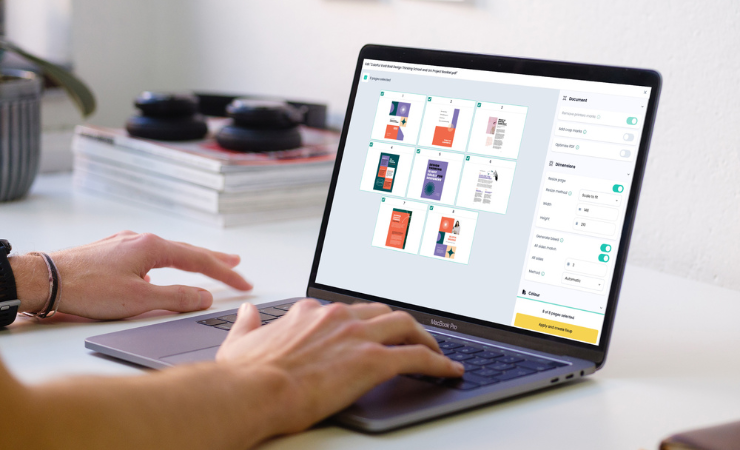
Artworker’s software automates the artwork approvals process for printers of all sizes. From checking resolution and bleed, to resizing and converting colour spaces, the platform offers a branded customer facing portal and can integrate with existing MIS and web-to-print systems – or operate independently.

“We just want to be the best at the artwork approvals process,” says Mr Duckworth. “We want to increase the level of automation as much as possible over time, to free up time within the printing company.”

The platform is priced to appeal to smaller rms, with tiered costs, and no fixed contracts. There is also a Zapier integration and open API for deeper customisation.

“We’re not trying to spread ourselves too thin,” Mr Duckworth adds. “But we are trying to solve a real operational challenge – and it’s a challenge that is only going to grow as print runs get shorter and customer les get more complex.”

Bridging the gap

Nate Duckworth, co-founder, Artworker

Hybrid Software offers enterprise-scale solutions while maintaining an agile, problem-solving approach. Its Cloudow platform provides an end-to-end work ow and production automation system, but its success often hinges less on the software itself and more on how it is implemented.

“It’s not about dropping in a massive new system all at once,” explains Thomas Elton, Cloudow product manager at Hybrid. “We often recommend focusing on a few real pain points to begin with. If you can solve those in a way that shows value straight away, you build trust.”

“We are trying to solve a real operational challenge – and it’s a challenge that is only going to grow as print runs get shorter and customer les get more complex.” – Nate Duckworth, co-founder, Artworker

Hybrid’s approach focuses on incremental automation, reducing the manual burden on skilled operators and giving them the ability to oversee more work, rather than being bogged down by repetitive tasks. “Let them keep the final decision,” Mr Elton says. “But give them tools that get them 90% of the way there.”

Automation as necessity

Kelvin Bell, sales director at web-to-print specialist Vpress, sees automation not just as a business advantage, but as a commercial imperative.

“You’re doing away with the process of paying someone to be able to enter the data multiple times where there’s potential human error,” he says. “Web to-print, if it’s done correctly, should pay for itself. If it doesn’t, it’s not being done right.”

Vpress positions itself as a change partner, helping PSPs and organisations such as Amazon, Deloitte, and GSK move incrementally toward a more integrated, digital-first business model. “Printers would rather spend a million on a piece of tin than £10,000 on a piece of software that will save them a fortune,” Mr Bell notes. “But automation isn’t a single step. It’s a destination.”

Thomas Elton, Cloud ow product manager, Hybrid Software

One of the key strengths of the Vpress platform is its ability to support seamless integration with more than 250 third-party systems, tailoring automation around the customer’s own workflow.

“We start with as low a deal as possible, sometimes a few hundred pounds,” Mr Bell says. “And we scale from there. We’re not in it to sell and move on. We partner our customers to success.”

A question of trust

One recurring challenge for workflow software providers is cultural rather than technical: how do you build confidence in automation?

“Some operators have a feeling for what looks right on press that they can’t put into words,” Mr Elton from Hybrid Software says. “They’ve got decades of experience. So, the idea of just hitting a button and letting software take over can feel like a big leap.”

“The idea of just hitting a button and letting software take over can feel like a big leap.” – Thomas Elton, Cloud ow product manager, Hybrid Software

Kelvin Bell, sales director, Vpress

The key, he says, is proving value incrementally. Artworker’s Nate Duckworth agrees: “We’re not trying to replace people. We’re trying to remove the repetitive manual tasks that take up their day, so they can focus on the creative or complex jobs that really need a human touch.”

Canon and Vpress also emphasise the importance of control, not just convenience. “Web-to-print and workflow give the control and give the confidence that it’s going to go through in an affordable way,” states Mr Bell. “You’re going to manage and maintain margins by reducing costs.”

“Automation isn’t a single step. It’s a destination.” – Kelvin Bell, sales director, Vpress