The discussion gets underway
It’s no secret that printers have been under pressure from falling margins and competition from digital media. How can they respond? Is it time for fundamental business transformation? A roundtable discussion organised by Ricoh and Digital Printer sought some answers.
Sometimes, the expectation on a printing company to extend itself as a marketing service provider (MSP) can become predicament. Freddie Kienzler of Southend printer Formara tells a story that illustrates this well.
‘We had a very good customer say to us, can you write me an app? We know nothing about that, but we found someone to do it and the customer was delighted. Then they said, now can you sell ad space on the app? We don’t have the staff or skills for that, and we’ve still not found anyone to do it. We’ve got this opportunity and we don’t know where to go for help. How on earth is a smaller printer going to get help and advice on becoming an MSP?’
Mr Kienzler told this story at the start of a roundtable event held by Digital Printer and Ricoh. Its context was a report from Pira, produced as part of Ricoh’s Business Driver Programme. The report – entitled ‘Things that are making printers change’ – states that there are two major factors that are making printers change the way they operate: print has become commoditised; and printers cannot attract new, profitable customers with existing services.
It goes on to suggest that business transformation to become a ‘value creator’ ormarketing service provider is the best option to break free of these constraints on print businesses.
Do printers agree with this though? If so, how can it be achieved? Should they build, buy or partner to achieve it? How able are they to even take a step back and assess their businesses in such a strategic way? These were questions that Ricoh was seeking answers to.
Around the table
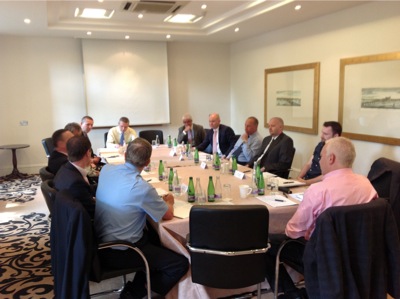
Mr Kienzler was joined at the roundtable event, hosted by Digital Printer editor Andy Knaggs, by ten further print business leaders: from Barnwell Print in Norfolk came Julian Barnwell and Richard Prior; from Headline Design came Mark Warner; Magic Mouse’s managing director Derek Evans attended, as did Mask Documents’ Julian Mason; Paul Talbot of Stonebridges, Dave Sharpe from Twist Print, Lee Bucktrout and Marie Pay from UK Postings, and Wellington Press managing director Nick Murray also took part in the discussion.
It was a robust discussion, and one which the attendees were happy to continue afterwards at Whitmar Publications’ Print, Design & Marketing Awards ceremony on the River Thames. Indeed, subsequently a LinkedIn group has even been created to allow the participants to keep talking.
To Mr Kienzler’s point about not having the necessary skills and staff to see through a business opportunity, there was a simple riposte from Julian Barnwell. ‘We retrained a member of staff. Keep control of it. Keep control of the margin,’ he said. Derek Evans agreed: ‘We did the same thing. We could not find anywhere to outsource to, and if you cannot outsource, you need to look within and start building, and it’s a very long process.’
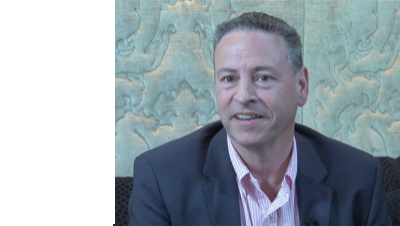 Derek Evans, Magic Mouse
It would be fair to say that these two gentlemen’s businesses, Barnwell Print and Magic Mouse in Loughton, Essex, are already some way along a path to becoming marketing service providers. Not everyone present could claim to be so advanced however.
Mr Kienzler’s Formara is an example, and his business needs ‘to use our existing resources to keep making a profit’, he said. Dave Sharpe from Twist Print was not entirely convinced that the MSP route was necessary, saying: ‘I’m unsure that we need to do this. Years ago when I was a kid, my local newsagent sold videos, faxes, lots of stuff. I went back there recently and now it’s just basic. I asked him why and he said, it’s a reflection of my customers. That means a lot. It’s true to our business too; you can only sell what the customers want.’
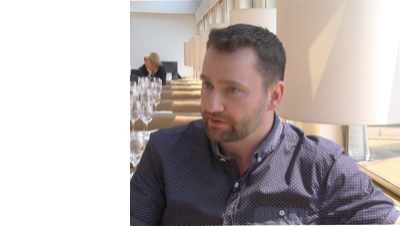 Dave Sharpe, Twist Print
Mark Warner of Headline Design however did see that the MSP model was a viable one for the future, and his company is already looking to tie printed pieces in with social media and online, but he put a question out to the other participants: ‘Is the reason to push sheets through the factory or to get more money from the client to prop up the factory?’
‘You need it all. You need your factory,’ responded Nick Murray of Wellington Press, adding: ‘Yes, there are people that are busy at the moment, but it’s not particularly buoyant. There has got to be an up at some point and the price of print will go up hopefully.’
For Julian Barnwell, it seems to be essential to be able to walk the MSP walk. He told the other participants: ‘We can offer these services but we have not bragged about it. It pains me that agencies are taking all the fat. We missed website design as an opportunity in this industry as well. The more you do online the more margin you get, and it gives us an excuse to talk to people. If you’re not in the game you cannot talk to people. It’s a tough call when you are a small company, but you have got to be in the mix.’
His own business has created mobile apps, is publishing to tablets, and is also the beta site for Ricoh’s Clickable Paper technology. It outsources much of the software development to places as far afield as Eastern Europe and the Philippines. One of the apps created – tied in with social media and printed magazines – is called Eat Out Norfolk. It gives Barnwell Print the opportunity to sell space to more than 600 pubs and restaurants. ‘It’s creating your own market. It’s all out there,’ he said.
Customer communication
UK Postings is a business that already offers far more than print, with other services including web hosting and data management. Lee Bucktrout revealed that he is in the process of taking himself out of the company’s day to day business to focus on developing additional services.
‘We are designing a customer questionnaire and some customers it will work fine with, but most clients don’t know what we do.’ Communication with clients is a key issue. Paul Talbot of Stonebridges Printers, a longestablished Bedford print firm, believes very much in the personal touch.
He said: ‘Any time I get an opportunity to talk to someone, just a window, I use that. People just want things now. They won’t even look at your website, they’re so busy with their own job. I try to personally deliver every job, have a coffee and a chat with them. It’s a relationship thing.’
Not everyone feels this is possible, with Nick Murray from Wellington Press admitting: ‘I’m at a point where I cannot have a good relationship with clients because I’m too busy.’ It is so important to have a captivating proposition for customers though. Magic Mouse’s Derek Evans stated: ‘These days I go into a client with an idea for their business. That makes their ears prick up.’ ‘We are business people,’ Julian Barnwell pointed out. ‘We should be able to give people some pointers.’
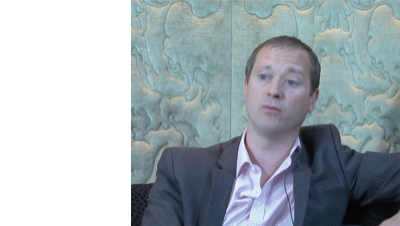 Nick Murray, Wellington Press
Partnering with other specialist providers was a recommended way to add valuecreating services to a print offering. This was certainly the experience of UK Postings. ‘Collaborate and co-operate, where someone else has expertise,’ said Lee Bucktrout. ‘It’s a far cheaper way, and the customer still comes back to you.’ His colleague Marie Pay added: ‘Five years ago it was a closed shop; we would not speak to anyone because we were concerned about losing customers. Now we are liaising with people that we know. You get trust with your clients and it opens up different avenues for you.’
Sound advice?
It seems there is little knowledge of, or faith in, the support and advice that is around to help printers make the transition to marketing service provider however. Asked if there was much help available, Mark Warner of Headline Design was forthright. ‘Absolutely not,’ he said. ‘It’s really feel your own way. Pulling it all together to find out what the strategy should be going forward; you are on your own on it.’
‘Historically we have gone to people like Ricoh and Canon. We tend to look to our machine suppliers to help us,’ said Freddie Kienzler. Julian Mason of Mask Documents commented: ‘I did not get very far when I tried that.’
Ricoh’s Adrian Stark said that there were support services in place, but the many dynamics involved in transitioning a print company to a wider marketing service provision make delivering relevant advice a complicated challenge.
As the roundtable event drew to a close, the participants were asked what each had taken from the discussion. The general view was that it had been good to discover that other companies were wrestling with the same issues, largely around finding time to understand customers’ needs and the directions they should take their businesses in, and communicating this to customers.
‘Change is a word that keeps jumping out to me,’ commented Dave Sharpe from Twist. ‘I would like to find out what teaching there is for change management. I’ve got great ideas, but making that change is really difficult.’
Julian Mason spoke for many in saying: ‘It has been thoroughly enjoyable. I don’t get out enough from the office, and more often than not clients are too busy to see me anyway. A couple of people have said we share the same problems. It’s something that needs to be addressed. But we don’t need a knee jerk reaction.’
‘There is no real panic to make these changes,’ agreed Freddie Kienzler. ‘Print is not going to disappear. Sit back and take the time to develop your business and try to move things along slowly. Forget the phrase MSP; just talk about how we can help customers improve their businesses.’