Best known for its international digital newspaper service, Stroma has found that a switch to full colour inkjet is opening up other types of work. By Simon Eccles.
Any time that you’ve read the name Stroma in the press over the past decade, inevitably it would be in connection with its short-run digital newspaper service. But since a move into full colour inkjet a year ago, the company has been able to expand into new short run publishing niches, using its extra capacity and capabilities.
As the first and so far only UK member of Océ’s worldwide Digital Newspaper Network (DNN), set up to offer local printing of international newspapers , the company originally received a lot of publicity in 2001. At first these were confined to black and white production on Océ VarioStream reel fed toner engines, but publishers really wanted colour.
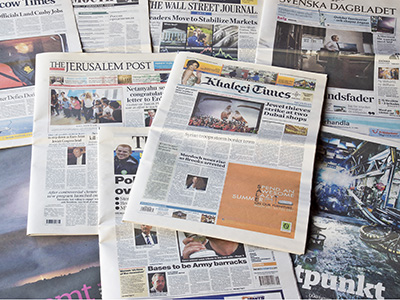
A year ago this was achieved at Stroma by installing a full-colour JetStream 1000 duplex inkjet line. This increased the appeal of the service to publishers and resulted in another burst of publicity for Stroma. The company works with Higgs International, Focus Media & Newspapers Direct and is currently signed up with publishers worldwide to output any of some 1400 titles on-demand (up from eight when it ran in black and white). It regularly prints about 50 to 60 titles per day. A selection printed on the day Digital Printer visited is shown above.
Set up in 2001, Stroma is currently an all-Océ, all-digital house, operating VarioPrint sheet fed presses as well as the new web fed JetStream and the older VarioStream 6000 web press formerly used for black and white newspapers. Apart from the JetStream, colour is available through a sheetfed VarioPrint CS650, Océ’s version of the Konica Minolta bizhub Pro 6500 colour toner engine. Clients include John Lewis, Starbucks Coffee Company, Qantas, M & C Saachi, Kaplan Publishing, 7 City Publishing, Balloon View and Positive Parents = Confident Kids.
According to Océ UK’s managing director Bron Curley, Stroma has been one of the largest participants in the DNN service, responsible for more than a quarter of the newspapers produced worldwide in five sites (Sydney, Singapore, London, New York City and Los Angeles) over the past decade. Last summer this was estimated as about 30 million copies worldwide.
‘The customer uploads the titles to a secure site and we download from there’ says Steve Brown, Stroma’s managing director. ‘There’s a naming convention for the files that tells the Océ Prisma front end how to impose the pages. The sizes need to be standardised – we don’t want to give publishers too many choices. Most now accept Berliner format for reduced broadsheet sizes. We do some tabloids but most European and US titles are happy with Berliner.’
Stroma’s west London location helps with this. Originally in Park Royal near the A40 road, it moved to a modern unit in Southall four years ago, close to the M4 motorway. It is only a couple of miles from Heathrow Airport, where international newspapers are required regularly – for instance Qantas Airlines puts Stroma’s same-day Sydney Morning Herald and The Australian papers on the first and business class seats of its aircraft. ‘It’s like having tomorrow’s newspapers today,’ Mr Brown says. DHL at Heathrow also consolidates Stroma’s newspapers with conventionally printed international titles that have been flown in from elsewhere, then distributes them.
Even so, a year on from the colour switch, Mr Brown admits that the flagship international newspaper service is not a big money-earner. The international titles are only printed in tiny numbers, typically from 50 to 400 copies per title (hotels tend to take about five copies each). ‘During last year’s Royal Wedding the Abu Dhabi royal family asked for copies of their local title to see its coverage,’ he recalls. ‘We printed one or two copies and got them their private jet at Heathrow in 20 minutes.’ Impressive stuff, but obviously not the basis of a full-time business.
Stroma first approached Océ more than ten years ago, after it put in a black and white press for transactional work. ‘We were small but had the promise and we were technically based. My father-in-law who lives in Berlin gave me a contact and we phoned them up, then had a meeting in a hotel car park. They came over and checked us out and that our location was right.’
Although the idea of printing international papers digitally on-demand around the world seemed very sound ten years ago, various unforeseen events meant that things never took off to the extent everyone hoped, Mr Brown says. ‘It was difficult for us, we had to get into the mindset. We started in the beginning of 2001 and had high hopes of increasing capacity as needed, but then 9/11 blew away a lot of that, with its effect on tourism. There were other issues, with publishers being very conservative. That’s always been a major problem, to change the mindset and understand how it works. Over the years we had our ups and downs. We realised quite quickly that we needed more products. We didn’t have a critical mass of titles to fill the machine. So we went out into the world to find other products for it. We started printing books in the daytime when no newspapers were going through.
‘Then the colour kit became available. There was the expense. Publishers said that colour was the holy grail but we still didn’t have the critical mass. Most of the JetStreams are used for transpromo, especially in the USA – there is three times the installed base there than the rest of the world. Transpromo is not so prolific in the UK and Europe.’
In addition, Stroma now has competition in the form of the big Newsfax organisation on the other side of London, which recently supplemented its battery of coldset newspaper presses with a Kodak Versamark VL colour inkjet line and is now offering digital print services to publishers. As it’s close to the Olympic village, the company is hoping to pick up business from international visitors in the summer. Mr Brown is somewhat equivocal about this. On the one hand he says: ‘I talked to Newsfax and they’re good guys. I think that it could grow the overall market for digital newspapers.’
Even so he’s not sure that there’s enough international business to go round long term, and he’s a bit wary about naming names of too many customers now that he’s got a significant competitor.
Fortunately switching to full colour on-demand has also helped bring in new UK business, from both UK publishers and other customers that want short run niche products. Some are very short run newspaper-type publications such as local authority newsletters, but also increasingly they are books and training manuals that are switching to colour. Although he is somewhat sceptical about the relevance of a web to print system for this type of work, Mr Brown says that a lot of contacts are made via Google, so his inhouse developers constantly work on keeping the search optimisation up to scratch. ‘We’re dealing with a lot of UK based publishers, doing short runs they’d previously have done by coldset as a service for regular customers, but with no profits,’ he says. ‘But we can act as bottom feeders and pick up that sort of work, and it’s good business for us. They are the likes of local authority type magazines or newsletters. For coldset these would be a nightmare, as the runs are not big enough. We provide a service to the established coldset printers. We will pass on work that’s too big for us, and they pass us the smaller stuff. We’ll get a few contracts out of it and it’s good business. However the international newspaper side is very small. It may pick up for the Olympics, but it’ll probably fall off again after.’
There’s even a small market for self-published newspapers. A website called Newspaper Club, set up by East London Design agency Really Interesting Group, lets anyone set up newspapers online via InDesign Server and a bunch of templates. See www.newspaperclub.com. Customers include other designers producing show pieces, fanzine writers, other self-publishers wanting a different format to conventional books, and people producing one-offs for the likes of weddings and parties.
Stroma prints the shorter Newspaper Club runs of one to 300 copies on Tuesdays and Thursdays. Prices start at £14 for a single digital copy, falling to £1.48 per copy for 300 and over. Longer runs go to a coldset printer. Generally the JetStream is used to run the DNN newspapers overnight, allowing capacity for the day shifts. ‘The bulk of our turnover comes from training companies and general publishing,’ says Mr Brown. ‘That’s underpinned the newspapers. But if we carry on growing the newspaper side it will give a significant hike in turnover.’ Going into colour has helped, he said: ‘The UK growth is welcome, and it’s also easier for us to administer.’
‘We’re trying various marketplaces to see if we can address them with this technology. The biggest challenge is the paper. It’s £90 per tonne for 80 g/m2 bond, which gives low contrast. £200 per tonne for glossy coated paper looks fantastic. It’s hard to get the balance between quality and cost.’
Newspapers are printed on standard newsprint grades, he says, and the inkjet quality matches coldset web offset newspaper. However, he has run tests on a variety of higher end coated and uncoated grades. We’ve gone through a huge testing phase with 20 different papers. The mills tend to send us bog standard stuff and hope it will work. It doesn’t, so then they put a coating on that’s better but costs a lot more.’
The best (though priciest) papers can give remarkably good results, he says: ‘We are seeing good results on Crown Van Gelder paper, though it’s 30 – 40% more expensive than normal grades. Mitsubishi is very good, but it’s 100% more expensive.’
The issue is getting the best combination of paper with the water based ink. ‘We have to dissipate the water, which takes a lot of power and heat to evaporate the water and dry the ink on coated papers, from above or below,’ Mr Brown explains. ‘Uncoated is absorbent so less hard to dry. Factors to think about with the print/paper combination is show-through, print quality and ink costs. UCR is valuable to reduce the total ink weight. The better the paper, the more ink you can use and the more margin you can charge.
‘For newspapers, standard newsprint is used. For other work we use uncoated or matt coated mainly – this isn’t the same as offset matt coated, just a bit more absorbent. It gives good results, especially for the transactional market.’
Lower-end JetStreams such as the 1000 tend to be used for transactional, transpromo and book work, but it’s evident that if the cost of higher grade papers can be justified then they can certainly up their game. ‘The machine cannot give litho results, but it’s not far off, especially on uncoated papers,’ Mr Brown feels. ‘This works well with business graphics, educational materials etc. It’s a move up from black and white collateral for these markets. We’re now trying to get to the part of making some money from this!’
Contact: www.stromaltd.co.uk
What’s an Océ JetStream 1000?
JetStream is the family name for Océ’s range of web fed single-pass inkjet production printers. The 1000 model is a full colour duplex model in the JetStream Compact series, which have a smaller one-box duplex footprint (5.8 x 2.6 metres, and 2.2 metres high) than the original 1100/2200 models, allowing them to fit into the tighter confines of typical datacentres, including breaking down to fit through standard double doors for installation.
Maximum web width is 520 mm with a print width of 515 mm and cutoff lengths from 152 to 1370 mm. Paper weights from 64 to 157 g/m2 can be handled. The web speed of 75 metres per minute allows for up to 1010 A4s per minute to be printed (ie two-up across the web, duplex). It can handle inkjet papers, plus laser grades, recycled newsprint and some pre-printed stock. The resolution is 600 x 600, equivalent to 1200 x 1200 dpi with multilevel dot modulation from 7 to 12 picolitre droplets.
Stroma re-reels its print for nearline finishing on Hunkeler equipment. The black and white newspapers on the older VarioStream were finished inline, but the nearline method allows more flexibility for non-newspaper jobs. The main engine and media transport is built by Miyakoshi in Japan, to Océ’s specifications and with its own DigiDot inkjet technology and inks plus SRA MP controller architecture. Océ’s PRISMA front ends are used, with support for variable data formats such as AFP/IPDS.
Contact: www.oce.co.uk