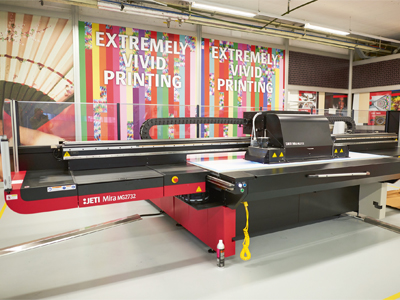
This Agfa Mira has been designed as a mid-volume flatbed but can be fitted with a roll-feeder across the front for flexible media.
The trend in wide format printing is for bigger, more productive printers that can satisfy a range of applications, says Nessan Cleary.
Wide format has stood apart from the rest of the industry, perhaps because it has grown out of the sign market. Many signs are one-offs, have to perform against outdoor weather conditions and use substrates better designed for the construction industry than printing. Throw in extreme price sensitivity and a willingness to accept lower image quality over longer viewing distances and it is not hard to see why printers stayed away.
But all that has changed, with considerable growth in the market for wide format printing, accelerated by phenomenal improvements in this branch of inkjet technology. There are still many wide format users that define themselves as sign makers, but these days the market also includes exhibition graphics, retail displays and indoor point of sale signage as well as posters and vehicle wrapping, not to mention hoardings for construction sites, promotional gift items and even packaging. Oh, and also personalised wallpapers and furnishings and short run clothing, such as t-shirts for a local garage or rugby shirts for a school team. So, no wonder that many commercial printers are investing in wide format printing.
This is driving the major trend in wide format printing towards bigger machines with higher productivity. For many years there was a split in the machines available, from smaller, relatively slow printers capable of producing very high quality, to larger, more expensive flatbeds with much greater productivity but lower print quality. There are now a growing number of mid-range machines that offer excellent image quality, suitable for viewing close-up, with good productivity at a reasonable price. There is a basic choice between roll-to-roll printers for flexible materials, flatbeds for rigid substrates or hybrids that can handle both. There are advantages to each type and choosing the right machine depends on understanding your mix of work and prioritising for the most common type of media.
Roll-to-roll printers
The majority of roll-to-roll printers tend to be small printers, typically around 1.6 m wide, but there are a number of 3.2 m machines aimed at higher volume production, including several launched this year. Just about all of these printers can be used to print two separate rolls side by side so that you could print two jobs simultaneously. However, this is more effective if there is a split spindle; otherwise the rolls will have to have the same substrate, and the same amount of media, so that they unwind at the same rate.
Almost all of these printers use UV-curable inks, which will adhere to most substrates. Smaller printers will often use solvent inks, which are much cheaper, but the greater productivity and substrate flexibility justifies the cost with the bigger machines. The exception is HP, which also offers a number of 3.2 m wide printers with latex inks. This includes the Latex 1500, which should be available later this month. It uses HP’s 1200 dpi thermal printheads, together with auto nozzle replacement, an optical media advance sensor and an embedded spectrophotometer. There are several options available for it, including a dual-roll kit for printing two rolls up to 1.6 m wide each, as well as in-line slitters and a double-sided day-night kit for automatically printing double-sided backlits. There is also an ink collector kit for porous substrates such as textiles and mesh banner.
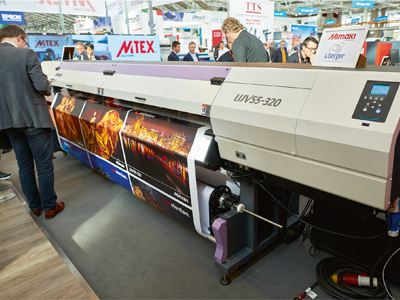
Mimaki’s latest printer is this UJV55, a 3.2 m wide roll fed
machine with LED UV curing.
Aside from HP, most other vendors use UV-curable inks but there is a growing use of LED-curable inks. The main advantage of LED curing is that the lamps have a long life and there is no change in performance over their life span. Also, LEDs work at a lower temperature, which is useful for heat sensitive materials. Mimaki recently launched its latest roll-to-roll UV inkjet printer, the UJV55-320. This is a 3.2 m wide machine that uses LED curing. It has a seven colour inkset – CMYK plus light cyan, light magenta and white, which can be used to print up to three layers for window graphics and backlit day and night signs. Mimaki has added an LED light box after the platen to make it easier to judge how well these layered effects are printing.
Agfa also has a 3.2 m wide printer, the RTR3200i, which comes with a choice of six colours or four plus two whites. There is a mesh option for printing to mesh without liner and it even comes with a trolley to load heavier rolls up to 150 Kg. The average production speed is around 65 sqm/hr though it can produce 127 sqm/hr in draft mode, suitable for banners.
Hybrid printers
There is an obvious attraction in choosing a hybrid printer that’s capable of handling both rigid and flexible materials. Steve Collins, wide format manager for Agfa UK, said: ‘We normally say that if there’s a 50% breakdown between the amount of roll fed and rigids that you want to print then a hybrid favours that because there is less wastage and it’s easy to move back and forth between the two types.’ The most obvious approach is to start with a roll-to-roll printer and add tables either side to feed the rigid boards through the platen. Most of these printers rely on a belt driven system to pull the boards to the platen, usually with a vacuum at the platen to hold the boards steady for the printing and curing.
Fujifilm used Fespa to show off a new printer, the Uvistar 320 Hybrid, which was officially launched at drupa. It is a 3.2 m printer that has been designed from the outset to handle both rigid and flexible materials. Thus it has a very deep top platen that helps to pull rigid materials into the machine so that it is relatively easy to feed boards one after the other. It has nine colours – CMYK plus light cyan, light magenta, light black, orange and white. Last year Agfa announced a new hybrid printer, the Jeti Tauro, and has since added automatic loading options to improve its productivity. It is a 2.54 m wide roll-fed printer that can take rigid boards up to 4 m long. The standard configuration is for six colours but there are options for white ink and primer.
EFI has a number of production printers designed around roll-to-roll chassis as hybrid machines. These include the LX3 Pro, first shown to the European market earlier this year at Fespa, a 3.2 m wide printer that uses LED curing. It has a new technology, UltraFX, for inline clear printing that is said to improve image quality and smooth over visual artifacts.
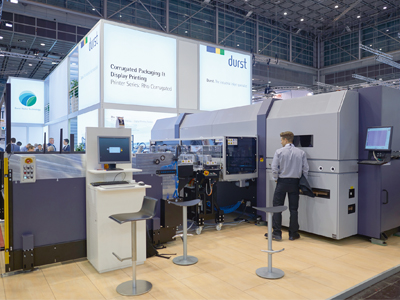
The Durst Rho 1312 AF with automated loading for rigid materials.
Durst sells the Rho 1312 which is based around a hybrid chassis but normally configured for handling rigid materials with tables and automatic loading. The maximum print width is 2.5 m though the printer can produce up to 620 sqm/hr. The standard inkset is CMYK but there are options to add two other colours with a choice of light cyan and light magenta, or orange plus either green or violet.
Durst also has a new hybrid printer, the WT250, that uses a water-based UV ink that produces a very vibrant, glossy image, with a low film weight. Its target markets are short run packaging applications and point of sale graphics.
Hybrid flatbeds
Recently, a new approach hybrid printer design has emerged with several flatbeds with optional roll-feeders. The claimed advantage is that the substrate stays still, held in place by a vacuum across the whole bed, while the shuttle with the print heads and curing lamps moves. In theory a flatbed is more accurate, particularly its front to back registration, but in practice there is very little difference. A good example is Screen’s Truepress W3200UV, built by its subsidiary Inca Digital. This takes boards up to 3.2 x 1.6 m, with options for light cyan and light magenta as well as for white ink. The latest version can produce 184 sqm/hr in flatbed and 230 sqm/hr in roll-to-roll operation.
Agfa has a new flatbed, the Jeti Mira, which comes in two sizes. Both are 2.7 m wide, but with a choice of 1.6 m or 3.2 m in length. The advantage of the bigger model is that you can load media at one end of the bed and prepare it, while printing to another board at the other end. An optional rollfed system takes media up to 2.05 m in width.
Canon sells the Arizona series of flatbeds, which include its largest model, the 6100 series, designed for the mid-volume market. It is a six colour printer with an option for white ink. Canon developed automatic cleaning for it, which has now been added to its lower volume Arizona 1200 series.
Production flatbeds
The final category is the high volume printers, which are designed for flat-out production of rigid boards. The two market leaders here are HP with its Scitex range and Inca Digital with its Onset series, which are distributed by Fujifilm. HP’s latest printer is the Scitex 9000, which is really a stripped down version of the top of the range Scitex 11000. It can be upgraded to the 11000, mainly by adding automatic loading to improve its productivity. The advantage of this approach is that customers can buy the cheaper 9000 and then invest further if they have the volume of work to justify this.
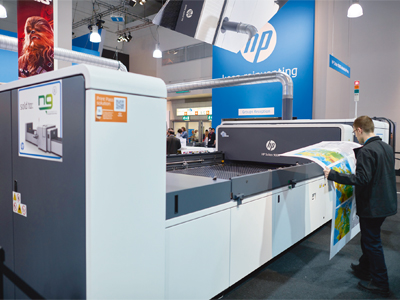
This HP Scitex 9000 can be field-upgraded to the top of the range Scitex 11000 flatbed.
At the end of last year Inca Digital announced the Onset X, a series of three printers configured with one, two or three sets of CMYK printheads, plus a combination of light cyan, light magenta, white and orange. The top of the range X3 can produce 900 sqm/hr or 180 beds/hr. John Mills, CEO of Inca Digital, says that the main market is for retail graphics, adding: ‘The market for ultra high end machines is about burst capacity.’
Ultimately machines of this speed are designed to replace multiple slower inkjet machines as well as screen printers, even challenging offset presses for some applications. They are built to last and to be upgradable to protect the investment cost. As such, they have evolved beyond wide format printers into production presses.