
Thomas Valjak, general manager and vice president for HP Large Format Design Business EMEA
Sign & Digital UK marks the first public sighting of HP’s super-fast PageWide large format printer. Simon Eccles assesses its prospects.
Shaping up to be the most significant newcomer at this month’s Sign & Digital show is the world’s first public showing of PageWide by HP. This ‘very fast’ 40 inch (1016 mm) wide single-pass large format inkjet technology was first revealed last June at an HP Designjet Production Summit in the USA, a couple of months after Digital Printer surveyed the fast wide format market which at the time was dominated by OEMs based on Memjet single-pass print heads.
The new PageWide printer models are not due for official launch until this summer, but the company’s European managers could not resist a couple of tasters to catch first the largest potential market in the UK, and then a couple of months later at FESPA in Cologne.
Although no prior announcement was intended for Sign & Digital, news leaked out, so Thomas Valjak agreed to speak to Digital Printer about the new model and its prospects. He is the general manager and vice president for HP Large Format Design Business EMEA.
‘We will display a product based on PageWide for large format printing at Sign & Digital UK,’ he said. ‘It will likely be one printer and exactly which configuration I can’t say at the moment; that’s still being worked out. The timing means we cannot reveal the product name or specs or things like that, but it is a wonderful opportunity, not to be missed, to show the technology to customers in the UK.’
PageWide is the name of the single-pass inkjet technology and associated architecture, not the name of the printer. It will be aimed at the same sort of CAD and mid-range graphics markets as the company’s other ‘production printers’, which all use the Designjet name followed by a model number.
Stopwatch speculation
What speed will it be running at? ‘Very fast’, is as much as Mr Valjak would say. It is possible to make a decent estimate, however. A video produced last year shows a pre-production model printing full-width square sheets in CMYK colour and cutting them in about 2.6 seconds, showing three being printed in sequence in 7.75 seconds. Assuming this rate can be kept up, that is 23 sheets per minute. A square sheet from this model is essentially one square metre, which works out as 1385 sheets or square metres per hour. Realistically it will be less than that: Mr Valjak said that the printer will have to stop to run head cleaning routines every so often, so 1200 sheets or square metres per hour might be a reasonable estimate.
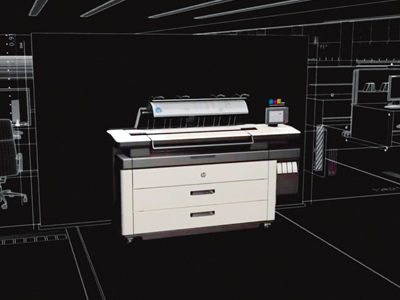
YouTube videos show two configurations, one a pure printer and the other apparently a copier with integrated high level large format (and likewise very fast) colour scanner. There are two front-loading drawers for separate paper rolls. The delivery is at the front too, presumably into a catch basket although that is not shown. The inks are CMYK and water-based. There is no sign of accelerated drying in the videos.

Office experience
The wide format PageWide printers build on HP’s experience with its single-pass Officejet Pro X series A4 printers, introduced a couple of years ago, which in turn descended from the earlier Edgeline single-pass departmental office printers. Pro X printers and MFPs cost between £290 and £470 and run at up to 70 A4 pages per minute in draft mode, or up to 55 pages per minute in decent quality mode.
They use a single 217.8 mm PageWide head, with 1200 nozzles per inch. Apparent resolution can be increased to 2400 x 2400 dpi with CMYK on special photo paper. The large format mounts five of the same heads in a print bar, staggered in two closely-spaced rows.
However, Mr Valjak said that there is a lot more to the large format model than just bolting more heads together: ‘There were a couple of difficult challenges to overcome with the technology, as you might imagine. There are so many nozzles that need to be kept alive for wide format, even though they are not firing all the time. So we had to look into a new ink formulation to prevent nozzle clog and control banding, and specifically to keep cleaning cycles very low. As a nice side effect we offer continuous high speed printing, because we don’t have a nozzle clog issue.
‘Then there were other things such as really getting the precision and the alignment correct across a 40 inch print bar. The two rows are placed fairly close to each other to ensure good quality line printing.’
Feeding the beast
Very powerful data transfer systems had to be developed as well, Mr Valjak said. ‘It took quite a lot of learning from the small format printers and one of the large challenges was coming up with the goods on the technology architecture internally, to process large amounts of data that is coming in pretty much real time. It’s a very powerful machine, processing in the range of Gigabytes of data per second into the printheads.’
The very high throughput potential also raises the question of how you are going to keep the printer fed with jobs. It remains to be seen whether the target users will really need to knock out 1200 square metres per hour. If they do, the printer should be able to handle it, Mr Valjak said: ‘In principle it is designed to offer continuous high speed printing without pauses between jobs to do the ripping. We’re going to offer our workflow software called HP Designjet Smartstream, which helps in the preparation, the PDF management and also in ripping the job and providing it to the unit. The combination of that software together with the PageWide product will give us continuous high speed printing. There will have to be a cleaning cycle every so often, but it is not like Memjet, which needs a frequent cleaning cycle.’
The Designjet Smartstream workflow was introduced last year and can be used across the company’s range of large format production inkjets. ‘Mostly people come in with a PDF document, with either many files or one huge file with mixed black and white and A3, A4 and large format all together. Traditionally an operator would need to tear that file apart to separate them and send them to different devices. Smartstream helps in making these processes almost automatic, filtering by large format, small format, colour, black and white, and giving a preview of the prints. It also deals with PDF errors, layer issues, font issues. We are really helping operators by getting down the job preparation times by at least 50%.’
CAD and beyond
Initially the wide format printers were to be aimed at the same sort of CAD/GIS market as most of the Memjet-based printers. However, the quality is better than anticipated, according to Mr Valjak: ‘The device was primarily designed for technical prints, line drawings, black and white and colour. But as well as renderings and GIS prints, what we found recently in testing was that the unit performs quite well for higher coverage print for general purpose poster printing. So we might show a couple of samples of that as well.
‘This is also one of the reasons why we decided to show it there, because even with the first implementation it is a CMYK-based, pigment-based machine. It’s going to be fairly OK for poster printing and things like that, where the print quality does not need to be the highest. It will not be immediately suitable for fine art prints, or production of photographic posters or things like that. But it’s fine for retail signage, promotional signage for restaurants, movie theatres, things like that.’
Greyscale hints
There was a hint last year that higher quality will be introduced in the future for models aimed at the higher quality graphics market, such as photo quality poster and signage work. So HP’s February announcement of the forthcoming 2400 nozzles per inch High Definition Nozzle Architecture (HDNA) technology for the T-series inkjet web presses might have implications for the large format models too. The T-series 1200 dpi heads are pretty well the same as PageWide.
The interesting aspect of HDNA is not so much the resolution as the fact that the heads generate two ink drop sizes. By firing pairs of nozzles in different combinations it is possible to get five grey levels at 1200 dpi, increasing the image quality to well beyond what you would get with binary printheads.
Will the graphics large format PageWide use the greyscale HDNA heads? Mr Valjak will not confirm it (but does not quite deny it either). The HDNA heads slot into existing T-series presses as an upgrade, and can also be used to boost print speeds. Presumably they would have the same effect on a hypothetical PageWide HDNA upgrade.
The rivals
There has been no public hint of pricing. However, the new printers will have to compete with the established competition of largely Memjet-based fast CAD/plan/GIS printers with a slightly wider 42 inch (1067 mm) print width. These include the RTI Vortex 4200 at about £68,000, Canon ColorWave 900 (from £120,000) and Xerox IJP 2000 (£105,000). These run at 1100 square metres per hour, which is in the same league as the PageWide video appears to show.
HP has an advantage over the Memjet OEMs because it owns its printhead factories and the heads are already in mass production. Will it pitch its single-pass wide format in the same field as these, or will it use its economies of scale and marketing clout to blow Memjet out of the water? We’ll know in a few months.