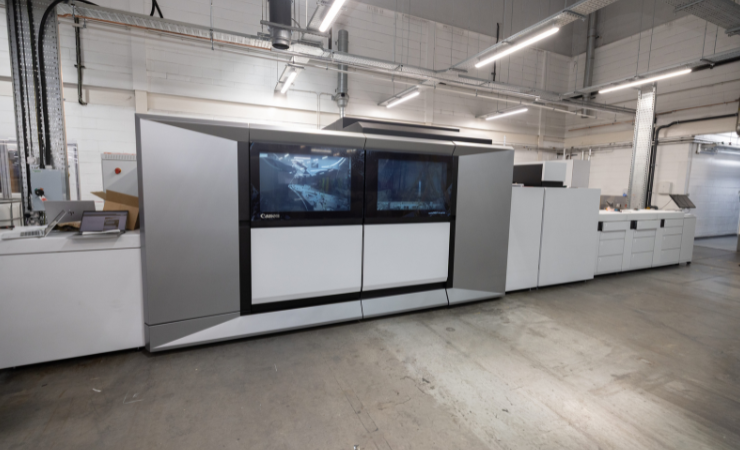
Route 1 Print has expanded its digital printing capacity with the installation of a Canon varioPRINT iX3200 high-speed inkjet press at its Rotherham production facility.
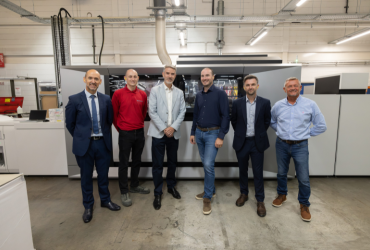
L-R: Chris Chapman (Canon), Cameron Mitchell (Route 1), Stuart Rising (Canon), Adam Carnell (Route 1), Lee Fowler (Canon), and Steve Bancroft (Canon)
The investment forms part of a £12 million factory-wide programme at the online trade printer’s 300,000sqft manufacturing site, aimed at increasing capacity and production efficiency.
The varioPRINT iX3200 uses water-based polymer pigment inks, ColorGrip conditioning technology and integrated quality assurance systems. Route 1 Print said the press will improve its output on uncoated and textured stocks, while expanding the range of applications available to its reseller customers.
Its ability to switch between media types will support production across Route 1 Print’s flat, folded and book products. The press can produce up to 9120 SRA3 duplex images per hour.
Jack Parks, head of Route 1 Print, said: “This investment is all about giving our customers more. More capacity, more flexibility and even greater confidence that we can deliver exceptional quality at speed, whatever the application.”
“Our reseller customers rely on us to help them stay competitive, and the addition of the Canon varioPRINT iX3200 allows us to do exactly that. It enables us to produce outstanding print quality while maintaining the fast turnaround times and competitive trade pricing that our customers expect.”
Mark Young, managing director of Route 1 Print, added: “Canon has been an excellent partner throughout this project.”
“From the initial planning and specification through to installation, training and ongoing support, their team has worked closely with us to ensure the new varioPRINT iX3200 was integrated seamlessly into our production environment. This investment strengthens our manufacturing capability today while giving us the flexibility to continue expanding our product offering in the future.”
Route 1 Print said the installation also supports its target of achieving Net Zero across scope 1, 2 and 3 emissions by 2035, with on-demand production intended to reduce waste and paper, ink and energy consumption.