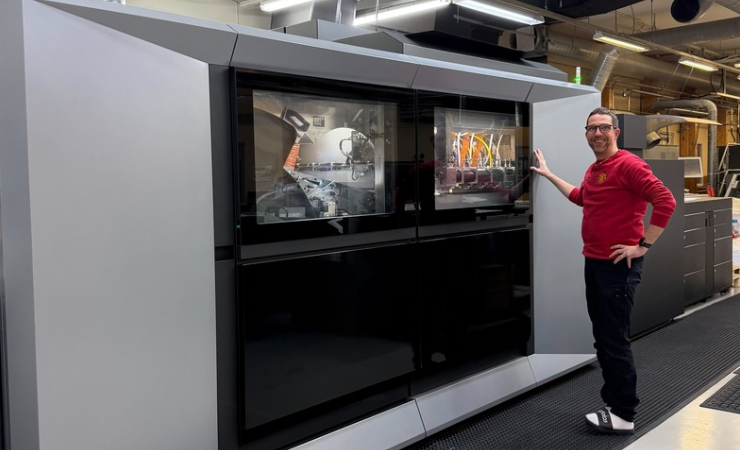
Heidelberg has secured its first customer in Finland for its Jetfire 50 industrial inkjet printing system, with commercial printer Waasa Graphics investing in the technology as part of its plans to develop a more flexible and efficient digital production operation.
The investment is intended to support the company’s response to changing customer requirements, including shorter print runs, faster turnaround times and more flexible production.
“With the Jetfire 50, Heidelberg is ideally positioned to meet the current challenges of international markets in terms of shorter runs and increasingly flexible production. This enables us to help our customers improve their competitiveness and expand their range of applications toward print-on-demand and customisation,” says Dr David Schmedding, CSO at Heidelberg.
Waasa Graphics managing director Karl-Magnus Stenström describes the installation as a strategic move towards a more industrialised digital production process.
“The Jetfire 50 enables us to combine high quality, fast turnaround times, and cost-efficient production, helping us remain competitive and create attractive print products together with our customers,” he commented.
According to Heidelberg, the Jetfire 50 incorporates an integrated scanner solution that monitors print quality during production, identifies fluctuations and automatically compensates for them. Individual printhead nozzles are also continuously monitored, with any nozzle failures corrected during operation without affecting production output.
The system uses Heidelberg’s Color Grip primer to support printing on a range of substrates, including coated and uncoated papers. The primer fixes the ink to the substrate surface, broadening the range of materials that can be used.
Mr Stenström says the Jetfire 50’s printable format of 337 × 504mm and paper grammage range of 60 to 350g/sqm are suited to the company’s existing order profile. He also points to the system’s automation capabilities and user interface as important factors in making industrial-scale digital production practical.
The installation has been integrated into Waasa Graphics’ production environment through Heidelberg’s Prinect workflow ecosystem. The company has implemented a fully integrated Prinect Production Manager alongside the Jetfire 50, with digital printing systems from a third-party supplier also connected to the workflow.
The integration is intended to provide a unified production environment across the company’s digital printing equipment.
Sustainability was another consideration in the investment decision. Waasa Graphics says its customers increasingly expect environmentally responsible print products, making sustainability performance an important factor when evaluating new equipment.
Among the factors considered were the Jetfire 50’s water-based inks, which are free from volatile organic compounds (VOCs), its energy consumption and the deinkability of printed products. The latter has been confirmed by Ingede.