London fast turnround digital print specialist 1st Byte signed a letter of intent for a Landa sheet fed nanographic press at drupa. It has also ordered an SRA3 format HP Indigo 7600 press to replace one of its three existing Indigo 5000 presses.
See also the longer feature on 1st Byte in Digital Printer July, here.
Other recent installations at the company include the UK’s first New Bind Pioneer PUR binder and a Watkiss SpineMaster SquareBack former for stitched booklets.
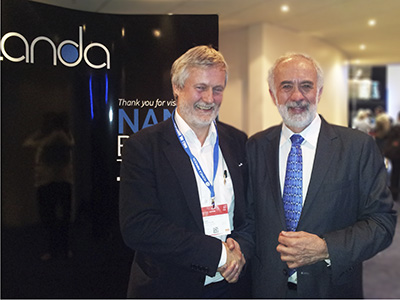
Managing director Lawrence Dalton (pictured above left, with Landa founder Benny Landa) has been interested in a B2 format digital press for more than a decade. It’s well known that he placed an order for two B2 Indigos after the company showed a prototype called XP2 at drupa 2000. These were never delivered as the project was dropped before HP acquired Landa in 2001, so instead 1st Byte bought a Xeikon 5000 web fed press to handle jobs that were too big for its existing SRA3 format Indigos.
The all-new HP Indigo 10000 B2 press launched at drupa 2012 is an entirely new design. Mr Dalton says that its large size and weight wouldn’t fit in the tight confines of 1st Byte’s two-unit factory in Baker’s Yard, in the Clerkenwell area of London. The Landa design is much more compact and weighs less.
However, he doesn’t anticipate delivery of the Landa press for a couple of years at least. In fact he said that the actual delivered press may not even be made by Landa itself, but one of the three licensees announced at drupa: Heidelberg, Komoro or manroland sheetfed. ‘Landa had to show working machines at drupa, but I wouldn’t be surprised if they don’t decide to concentrate on manufacturing the NanoInk and leave press making to the licensees,’ Mr Dalton said. ‘The real technology is in the ink, and Benny Landa has always been good at that.’ The letter of intent is essentially a deposit, reportedly for 10,000 Euros. This puts 1st Byte on the list for one of the early presses, whatever the source, he explained.
It’s likely that 1st Byte would choose a B2 format press, he said, but might even go for a B3 model if that suits the company requirements nearer the decision time. He’s most interested in its potential to bring costs down so that digital print competes with offset for longer runs.
‘It gives us two years to build up the clients for longer runs,’ he said. ‘The HP Indigo 7600 will allow us to go for somewhat longer runs in the meantime, as its click rates are more favourable than for the 5000.’ The press will also have the white ink option, allowing 1st Byte to expand its offerings by printing on plastic or dark coloured and metallised papers. ‘We also quite like the new raised ink feature and the effect is quite good, but it will be a matter of trials to see if it’s what the clients want,’ he said. This gives a raised effect similar to thermography by building up multiple layers of ink. He added that he’s less convinced by the true embossing effect that’s possible with the new press by building up raised ink on a special cylinder liner sheet and using that as a mould for the sheets.
Landa showed several Nanographic presses at drupa in a variety of sheet and web fed configurations and formats, including the B1 format S10. Some were operating, others not. It described them very much as prototypes and admitted that there is a lot more development work needed to get performance and quality up to the desired levels. The paper transport and general running gear was made for Landa by Komori, while the digital print engines were made by Graph-Tech in Switzerland, with modified Kyocera inkjet heads. The UK’s Domino Printing Sciences has just announced it is acquiring Graph-Tech – read more here.
According to Mr Dalton, ‘Benny Landa is aiming to reinvent digital print in three areas: speed, quality and cost of consumables. If he succeeds in just two, he’s got a winner. If there’s only one then it’ll be tougher, but if he can keep the costs down then even without high speed and high quality it’ll be success. If it’s cheap to run but without high quality we wouldn’t be interested, though if the quality is significantly better than other digital presses we’ll want to have it anyway.’
* The New Bind Pioneer PUR gluer is the first in the UK. It features an end sheet lifting device that allows end sheets to be placed in the clamp with the book block. It was supplied by the UK distributor Encore Machinery.
* The Watkiss Spinemaster has been installed to achieve flat stacking for high quality books and brochures. Mr Dalton said that ‘An example is a recent job we produced, which was initially refused because the finish wasn’t acceptable. One of our neighbouring companies had a SpineMaster, so we asked them to put the job through it. The client was delighted with the result. We were delighted too – it saved us a 2000 run print job, and it saved us a valued client. So we bought our own.’ A significant proportion of 1st Byte’s production is sent abroad and an added benefit of the SpineMaster is that the finished booklets pack neatly and take up much less space. ‘It means fewer boxes to ship and, because the booklets pack tightly, there is less risk of damage in transit,’ Mr Dalton said.
Contact: www.1stbyte.co.uk and www.landanano.com