Xaar has launched a new white paper focused on digital braille printing, and has delivered two technical presentations at international industry events in Asia and Europe.
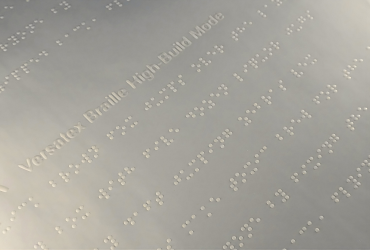
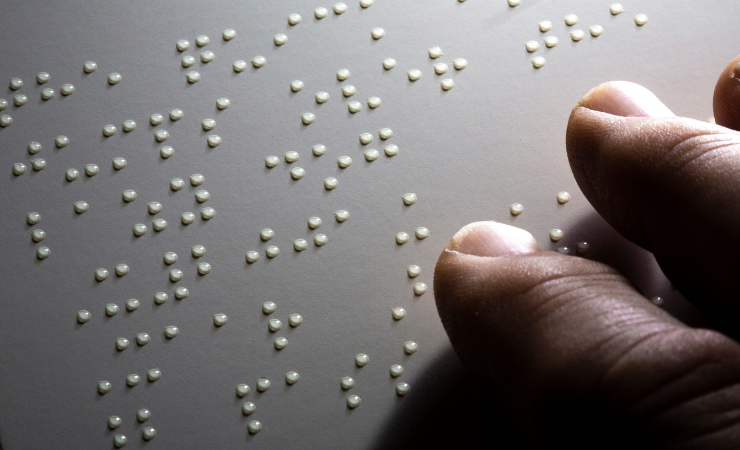
Braille embellishment can be combined with variable data printing
The company presented its latest thinking at Labelexpo Asia in Shanghai and at Packaging Europe’s Digital Print for Packaging (DPP) Conference in Berlin, outlining how industrial inkjet can support both packaging embellishment and accessibility. At the centre of both sessions was a newly published white paper titled Implementing braille printing in labelling & packaging with Xaar’s Versatex printbar, which examines how digital inkjet technology can be used to produce effective, compliant braille.
In Berlin, Xaar’s head of strategic marketing, Neil Cook, explored how high-build varnish embellishment can be combined with variable data printing to support blind and partially sighted users. His presentation focused on the growing alignment between accessibility legislation, brand expectations, and consumer needs, and the role inkjet can play in meeting those requirements. Cook highlighted the ability of inkjet to apply tactile features with greater precision and consistency than analogue methods, particularly when working with high-viscosity, particle-rich varnishes.
“Accessible packaging is moving from a niche requirement to an essential part of the brand experience. High build varnish delivered through inkjet provides the accuracy and consistency needed for tactile features while still supporting variable data,” said Mr Cook. “It allows converters to meet both creative and regulatory demands in a single process and demonstrates how digital print can have a meaningful impact on the everyday lives of consumers.”
At Labelexpo Asia, Xaars sales and application development manager, Asia, Shawn Feng, addressed the challenges converters face when integrating digital capabilities into existing analogue production lines. He outlined how the Versatex Printbar offers a modular, ready-to-use approach that can reduce development time and cost. Applications discussed included high-opacity white, tactile varnish effects, and compliant braille printing, with a focus on helping converters access premium label markets.
“Converters want to add more value without adding more complexity and that is exactly where digital inkjet is proving its strength,” said Mr Feng. “With Versatex we are showing how embellishment and braille can be achieved more flexibly and with far greater control.”
The Versatex Printbar supports two dedicated braille production modes. High-Build mode produces dots up to 200µm at speeds of up to 19 m/min, while High-Speed mode operates at around 22 m/min and meets Marburg Medium and ISO 17351 standards. Both modes are designed to deliver consistent, readable braille for pharmaceutical, packaging and labelling applications where accessibility and productivity are critical.