DPI Laboratory has launched the Catalyst Printing Platform, a UV production architecture designed to bring hardware, ink delivery, colour management, coatings and workflow software together within a single system.
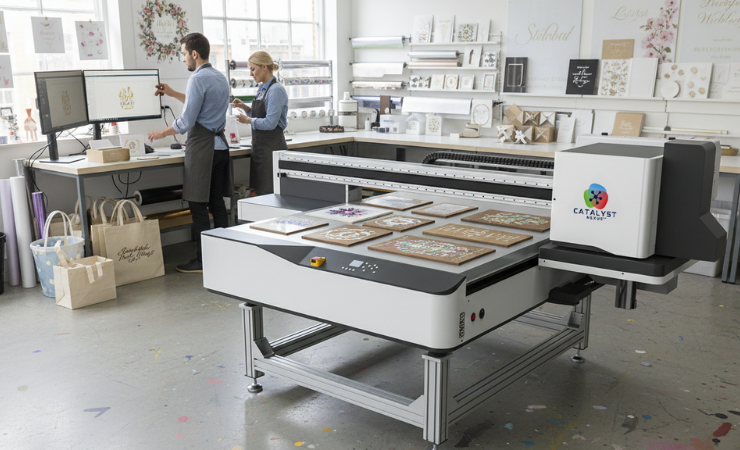
Alongside the platform launch, the company has also introduced the Catalyst Nexus, a modular UV printer aimed at larger-format and higher-output production environments.
According to DPI Laboratory, the Catalyst Printing Platform marks a move away from standalone equipment and towards a more structured manufacturing environment. Developed using systems thinking and design thinking principles, the platform is intended to support reliability, workflow consistency and long-term scalability.
“Our industry has spent years debating features,” said Lon Riley, founder of DPI Laboratory. “But production doesn’t fail because of features. It fails because systems break down. We built the Catalyst Platform to create structure around reliability and workflow discipline, because growth only happens when production is stable.”
The Catalyst Printing Platform includes three UV systems: the Catalyst Nanos, aimed at businesses entering production; the Catalyst Aventra, designed for sustained throughput and reliability; and the new Catalyst Nexus, which is positioned for larger-format and higher-volume growth. DPI Laboratory said all three systems operate within the same architecture to support predictable performance and expansion.
The Catalyst Nexus features a large-format printable area, multiple Epson print heads with expanded colour configurations, and a detachable gantry system. It also operates within the Catalyst Platform’s integrated bulk ink delivery and workflow structure.
DPI Laboratory said the new platform and printer reflect its focus on combining UV hardware with software, ink systems and workflow tools as part of a wider production environment.