
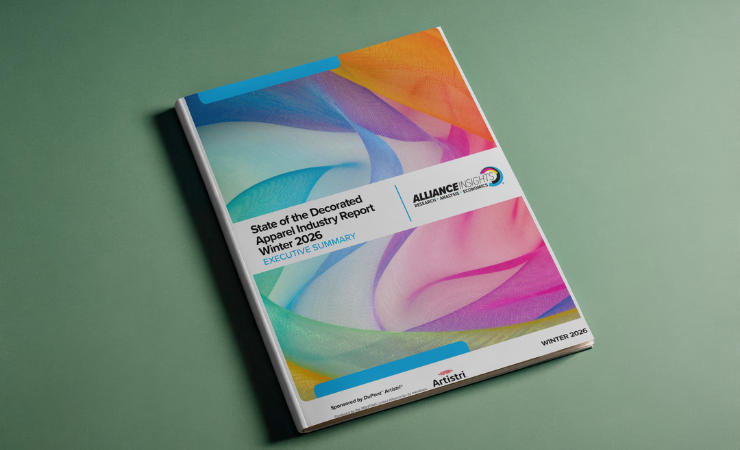
Printing United Alliance has published its State of the Decorated Apparel Industry Report, Winter 2026, highlighting continued pressure on margins despite modest sales growth across the sector.
Based on responses from 68 companies across the United States and Canada, the report reflects a broad cross-section of apparel decorators, with annual revenues ranging from under $250,000 (£186,000) to more than $20 million (£15 million). Most respondents operate multiple in-house decoration technologies.
The findings show that sales growth has been limited, increasing by an average of 2.0% during the first three quarters of 2025. While 39.7% of businesses reported higher sales, 60.4% saw either flat or declining performance. At the same time, operating costs rose by an average of 8.1%, outpacing average price increases of 7.1%, creating sustained pressure on profitability.
This imbalance is reflected in margins, with pre-tax profitability increasing for just 26.7% of respondents. For the majority, profitability remained flat (45.0%) or declined (28.3%), indicating ongoing challenges in converting top-line growth into improved financial performance.
Looking ahead, expectations for 2026 are mixed. Around 35.5% of respondents anticipate improved business conditions, while 32.3% expect conditions to remain the same. However, 21.0% say there is too much uncertainty to form a clear outlook, pointing to continued volatility in the market.
Against this backdrop, businesses are prioritising operational efficiency. Productivity (74.2%) and cost control (72.6%) are the most commonly cited priorities for 2026, followed by marketing and brand-building initiatives (50.0%). Investment in automation (48.4%) and increasing production speed (45.2%) also feature prominently.
Key concerns remain closely tied to cost pressures. Rising labour costs and broader economic conditions are each cited by 51.6% of respondents, while concerns around substrate costs and maintaining profitability were each highlighted by 48.4%.
The report also examines wider industry factors including tariffs, capital investment plans, print-on-demand performance, and sustainability practices, offering a snapshot of a sector balancing growth ambitions with ongoing financial and operational challenges.