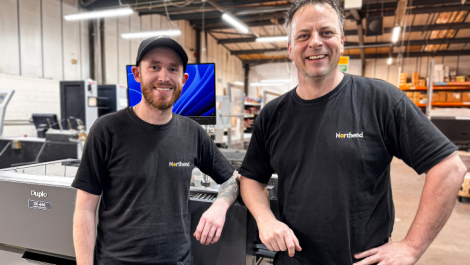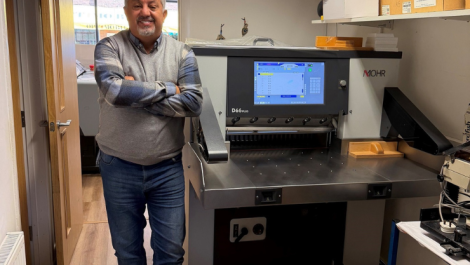
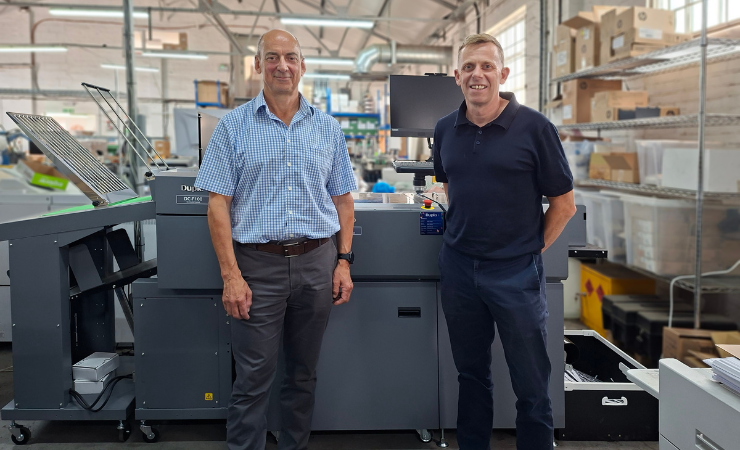
Impress Print has overhauled its digital finishing setup with the installation of a Duplo DC-648 multi-finisher and DC-F100 folder. The additions create a fully automated, press-side workflow that replaces several standalone machines. The Walton-on-Thames printer says the move has significantly increased efficiency, reduced waste, and energy use, and improved turnaround times.
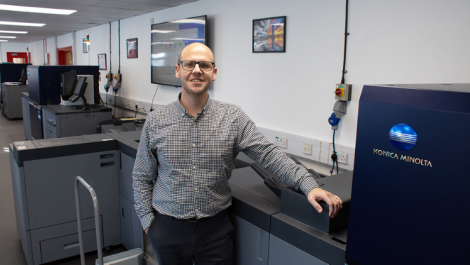
The company identified finishing as the one area of production that had not kept pace with rising demand for fast, short-run digital work. Managing director Mike Kille explained that the previous workflow involved multiple handling steps across different buildings. “A single job might be cut on the guillotine, moved to a creaser, and then taken to a folder before it could finally be boxed,” he said. “A single job would go through two or three machines before it could be finished. Now it is printed and it goes straight into the multi-finisher and it is done.”
Mr Kille added that the previous setup conflicted with the company’s environmental goals, as operating several machines increased power usage and the risk of waste. The new system consolidates these processes. “Everything was separate,” he said. “With the DC-648 and F100, we have brought it all into one place. The barcode system is set up, it is fully Fiery integrated, and the operator can print and finish straight away on the Duplo system.”
Positioning the finishing line beside the digital press was central to the upgrade. “The operator can print the job, put it straight onto the Duplo, and it runs through,” Mr Kille noted. “That was a big part of why we wanted it next to the press.”
According to Mr Kille, the impact on productivity was immediate. “For us, it was the speed of getting the finished work off. That was the aim of the purchase, to get jobs through more quickly.” He added that the simplified workflow has reduced internal pressure and improved visibility of job progress.
The consolidated system has also delivered environmental gains. “We are no longer powering two, three or even four machines. Everything is done by a single machine,” Mr Kille said. “It is straightforward, easy to set up and simple to use.”
He described the overall production environment as much smoother and more straightforward, adding: “The major benefit is the efficiency of producing the work. We know that when we send a job to that printer, it will be finished in the same location and quickly. Much quicker than before.”
The move forms part of Impress Print’s long-term sustainability strategy. “You pick something to start with and then build on it over time,” Mr Kille added.