
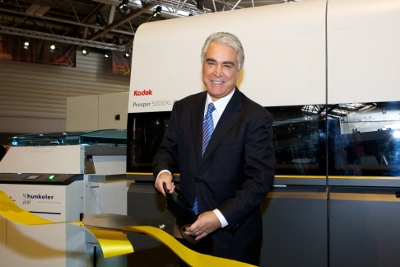
Kodak’s Antonio Perez.
The third day of September 2013 was when the new Kodak emerged – a different Kodak; one that in the words of Antonio M. Perez, its chairman and chief executive officer, is ‘a technology company serving imaging for business markets – including packaging, functional printing, graphic communications and professional services’.
It has been a long and tough road to this point for the company, which entered Chapter 11 bankruptcy protection in January 2012. Its restructuring process has seen the sale of its Document Imaging and Personalised Imaging businesses – the consumer film and photographic business that made its name – to Kodak Pension Plan (KPP), a long-standing pension plan of Kodak’s UK subsidiary. This $650 million deal (approximately £419 million) settled a $2.8 billion pension claim against the company, reportedly.
KPP has announced that these businesses will function under the name Kodak Alaris. Steven Ross, independent chairman of KPP, said that the organisation was ‘thrilled with the potential the new company holds for our plan members, our customers, and our employees’.
The new Kodak is a much smaller entity, having entered Chapter 11 with around 17,000 employees, and emerging with around 8500. Mr Perez said: ‘We have been revitalized by our transformation and restructured to become a formidable competitor – leaner, with a strong capital structure, a healthy balance sheet, and the industry’s best technology.’
The company has raised $695 million (£447 million) in exit financing, as well as paying off its debtor in possession lenders and second lien noteholders, while receiving approximately $406 million of new equity investments from participating unsecured creditors. Pre-bankruptcy stock is now cancelled, and therefore worthless.
Mr Perez said the target was ‘profitable growth’, and that Kodak is ‘on track’ to realise $167 million earnings on $2.7 billion of revenue in 2013. It forecasts EBITDA of $494 million by the end of 2017. He added: ‘We have the right technology at the right time as printing markets increasingly transition to digital. Our broad portfolio of offset, hybrid and digital solutions enables customers to make the transition at their chosen pace using our breakthrough technology solutions.’
During a press conference on the afternoon of 4 September, the company said that technologies such as Stream inkjet and its SquareSpot laser imaging technology would be key to its future, helping it to drive growth in packaging and industrial printing, and in ‘functional printing’ such as touch screen films and printed electronics. These, alongside its graphic arts business, will be key markets going forward. Toner-based technologies such as the Nexpress are also still important, though this market is more mature.
R&D is continuing and Mr Perez revealed that a 60-inch Stream print bar is under development – the current biggest size is 49 inches. He said that the financial balance sheet was ‘very healthy’, now that Kodak has ‘eliminated the costs that were dragging this company down for many years’. It holds approximately $500 million in equity and more than $800 million in cash at emergence, against a debt of $695 million. Around 87% of Kodak’s revenue comes from ‘annuities’, such as inks and plates.