
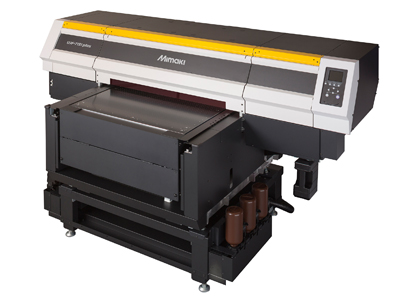
The new LUS-350 UV ink is compatible with the Mimaki UJF-7151plus, direct-to-object production flatbed LED UV printer.
A new Mimaki LUS-350 ink will be launched in summer 2016, which is suitable for a wide range of thermoforming applications and printing on automotive parts due to its durability.
The ink is compatible with the Mimaki UJF-7151plus and JFX200-2513 printers and will be available in CMYK, white and clear ink.
Up until now, it was necessary for objects to be formed prior to the images being applied manually or by screen printing. This new ink technology now allows thermoformed objects to be imaged before forming, using Mimaki digital printers running inks that will not crack or otherwise be damaged during the heat-based forming process. This process will provide a beautiful finish for a wide range of applications such as car parts, mock ups, moulded signs and more.
The Mimaki LUS-350 ink will stretch up to 350% when heated between 120 and 200 degrees centigrade. After cooling to room temperature, the ink’s rigidity is restored, while securely adhering to the moulded product without cracking or peeling. These characteristics ensure the new ink provides the necessary rigidity, durability and stretchability to serve a broad range of applications without any compromise in image quality. Images are initially printed on flat substrates using specialised imaging software and then formed into the desired shape using vacuum, thermoforming or other moulding techniques. Intricate textures and designs in fine decorative prints are retained even after moulding, with the additional benefit of being able to apply multiple layers of ink to create raised areas in the image for further enhancement, without having concerns about cracking or quality of adhesion.
The forthcoming launch of the new ink has been welcomed by Stuart Cole, national sales manager, industrial products for Mimaki’s UK & Ireland distributor, Hybrid Services Ltd, who commented, ‘This is a very exciting development for Mimaki users in the industrial sector who need to produce items with greater creativity in a less time consuming manner and more cost effectively than previously. Yet again, forward thinking technological developments from Mimaki will provide end users with greater flexibility and the potential to create and develop an ever wider range of bespoke products.’