
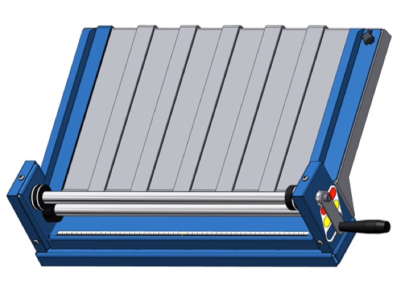
Early design image of the CreaseStream Card Creaser, which will be equipped with two rotary Tri-Creasers
A manual creaser will be launched by CreaseStream and the company said it will prove to be a ‘significant improvement’ over the manual matrix creasers which use a handle to apply a crease impression.
Owner Graham Harris said, ‘Our version speeds up production over those old technology methods by up to six times.’ The CreaseStream Card Creaser, unlike traditional desktop methods that rely on the user manually striking a crease into a motionless sheet one at a time, uses a rotary handle for operators to continuously drive sheets through turning shafts to produce up to two crease impressions simultaneously. The rotary handle compared to the pull down strike handle technique equates to a significant output speed increase that Mr Harris felt would eliminate the obvious frustrations suffered by countless designers, copy shops and digital print companies worldwide who he said, ‘rely too heavily on slow performing technology that does little more than cause bottle necks in production.’
He concluded, ‘Our beta version CreaseStream Card Creaser will be demonstrated on our stand using our very best Tri-Creaser technology and we feel sure to turn heads. Price can be a huge barrier for those who can’t justify buying automatic creasing machines and are forced to buy more affordable yet antiquated creasing methods that haven’t changed in decades, we simply wanted to do something about it, and shake up the market.’
CreaseStream are discounting their Card Creaser from £1,097 to £997 for the duration of the Drupa exhibition and hope that it can go on to fill this hugely vacant gap in the global creasing market.