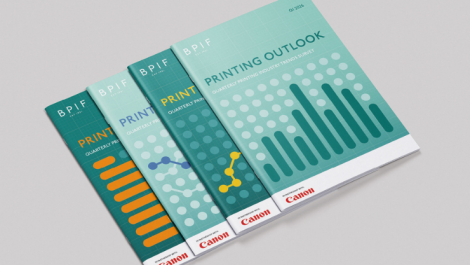

Political uncertainties and conflict in the Middle East are to blame for the UK printing and printed packaging industry’s downturn in Q2 2026, according to the latest BPIF Printing Outlook survey.
The data for Q2 2026 depicts an industry suffering from a concentrated period of cost increases that have necessitated some degree of price increases, but not quite to the degree required to protect cash flow, margins and profits – or to grow or maintain demand in many cases.
According to the survey, over two-fifths (42%) of printers experienced a decrease in their output levels in the second quarter of 2026. Less than two-fifths (37%) were able to hold output steady, whilst the remaining 21% achieved an increase in their output levels. The resulting balance (the difference between the ups and the downs) was therefore -21, a long way below Q1’s outturn (-2), and just below the Q2 forecast (-18).
Kyle Jardine, BPIF economist, said: “Companies have referenced confidence being hit by uncertainty, leading to delays in purchasing decisions and investments. Most costs have increased by similar amounts in a short period of time – but not all have been passed on as price increases. Orders and output have taken a knock, but the industry is expecting some degree of recovery as we move into the second half of the year.
“Despite the future direction of Government policy still being unclear, and the lack of endgame certainty over conflicts in the Middle East and Ukraine – the industry is forecasting that Q2 will be the low point for 2026 and that confidence and activity levels will improve in Q3.”
The negative outcome is the most negative output balance reported for six years – when output was restrained by the Covid shutdown. The downturn may be short-lived, the forecast for output in Q3 is more positive. Output growth is expected to increase for 33% of companies, a more positive prediction following a disappointing Q2.
Industry confidence was strongly negative in Q2 but has not sunk to the depths feared when the Q2 forecast was made in April. More encouragingly, the Q3 confidence outlook is marginally positive. Global conflicts and uncertainties have diverted an admittedly subdued, but improving, economic performance.
Charles Jarrold, BPIF chief executive, said: “Industry demand, profit levels, and concerns that some competitors are pricing below cost are the significant concerns being voiced by companies. Hopefully a pick-up in confidence, a fall in uncertainty, and an increase in demand in the second half of this year will go some way to allay these concerns. “Of course, some other persistent and common gripes remain; lack of investment support, an increasing regulatory burden, more obstacles in trading with the EU, recruiting difficulties, damaging effects of minimum wage increases, and inconsistencies in business rates – to list a few. We do of course voice such concerns in our regular representations to Government; we’ll find out more about the direction the new Prime Minister will take in the next few weeks and months.”
Concerns over the level of sales in the industry have increased to lead a reorder to the list of printers’ top business concerns. Sales levels sits ahead of profit levels, and the belief that competitors are pricing below cost. Fears of further knock-on effects of global unrest have eased but concerns do remain over conflicts in the Middle East and in Ukraine.
Sales levels was selected by 55% of respondents as one of their top five business concerns, up from 33% in April. Previously concerns over the level of global unrest had shot up to become the top concern. It was noted that the knock-on effects will be seen not only in cost pressures but a concern that the uncertainty will delay and dampen orders and activity; this is exactly what has occurred. Worries over the level of profits that are being generated has moved up the ranking to become the second ranked concern in July, selected by 39% of respondents, up from 32% in April.
The latest survey results do show that cash flow, margins, and profits have all taken a hit in the last quarter. Competitor pricing levels remains the third ranked business concern. This time with a 34% share of respondents selecting it, it remains an important issue, just slightly less so than in April, January, and in last October when it had a 53% share.