Italian print business Pubblicità & Stampa has expanded its wide-format offering by adding Kavalan PVC-free banner materials to its product range. The addition supports both business growth and its wider sustainability strategy.
Founded in 1979 and based in Modugno, the company operates from a 3000 sq/m facility with a team of 21, producing commercial print, point-of-sale materials, retail display graphics and signage using a range of print technologies.
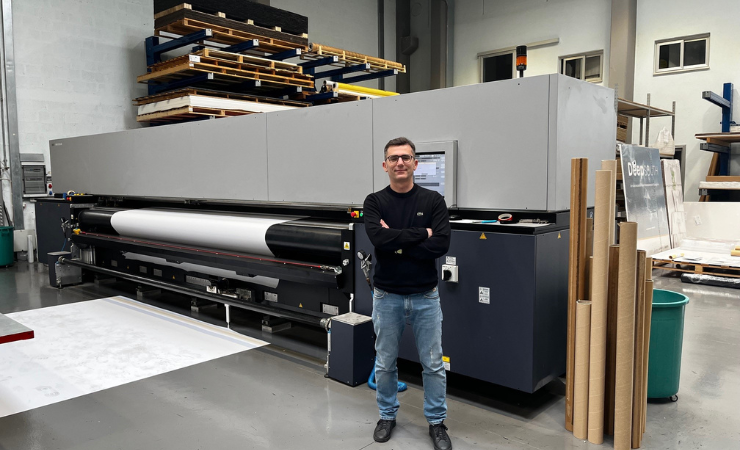
The company entered a period of expansion in 2020, investing in two high-performance printers to increase production flexibility and precision. The investment has enabled the business to broaden its service offering and grow beyond its traditional southern Italian customer base, with work now being carried out for customers in Rome, Milan and other parts of the country.
According to Beppe De Bartolo, CEO and digital printing manager at Pubblicità & Stampa, this growth has coincided with increasing demand for more sustainable print materials across Italy and Europe.
The company had already introduced several environmental initiatives, including the use of FSC-certified papers, UL Greenguard Gold -certified UV inks for large-format printing and solar panels to power production. In 2024, after being introduced to Kavalan’s PVC-free materials by Polyedra, it added Kavalan Sunlight Taichi and Sunlight Weldable media to its portfolio in response to customer demand for more sustainable signage solutions.
Discussing the applications of the new materials, Mr De Bartolo said: “We’ve used lighter materials and materials suitable for various applications, including black-back products that are more opaque and ideal for displays where you don’t want any light to show through from behind. It’s quite a broad range, and this is definitely something that people appreciate.”
He added that customer requirements vary depending on the application: “It was mainly about managing the materials. Some clients want materials that behave differently, particularly for mounting on various surfaces such as walls, so flexibility is key. The market is quite sensitive to these issues.”
While Mr De Bartolo acknowledged that some parts of the Italian market have yet to embrace PVC-free alternatives, he said performance remains a key advantage. “The key difference lies in performance. For example, on larger surfaces such as metal or wooden panels, the PVC-free materials respond better to temperature changes, whether hot or cold. There is already a wide range of materials available, offering improvements not only in terms of environmental impact, but also in terms of colour consistency and the final look and feel of the product.”
Nova Abbott, head of marketing at Kavalan, added: “It’s fantastic to see companies such as Pubblicità & Stampa leading the sustainability drive away from harmful PVC banner materials and towards more sustainable choices. As a result, the benefits of these alternatives are becoming more widely recognised across the entire Italian market, and the path to a more sustainable future for the print industry is clear to see.”