Heidelberg is strengthening its presence in India as it looks to capitalise on rapid growth in the country’s packaging and print markets. The trend is supported by rising domestic demand and the prospect of closer trade ties between India and the European Union.
The company says India has become a strategically important market, particularly for packaging, labels, and commercial print, as economic growth, urbanisation, and rising consumer spending continue to drive demand for printed packaging. Industry forecasts cited by Heidelberg suggest the Indian packaging market could grow from around $12 billion (£8.8 billion) today to $20 billion (£14.5 billion) by 2030, with strong momentum in pharmaceuticals, food, beverages, and e-commerce.
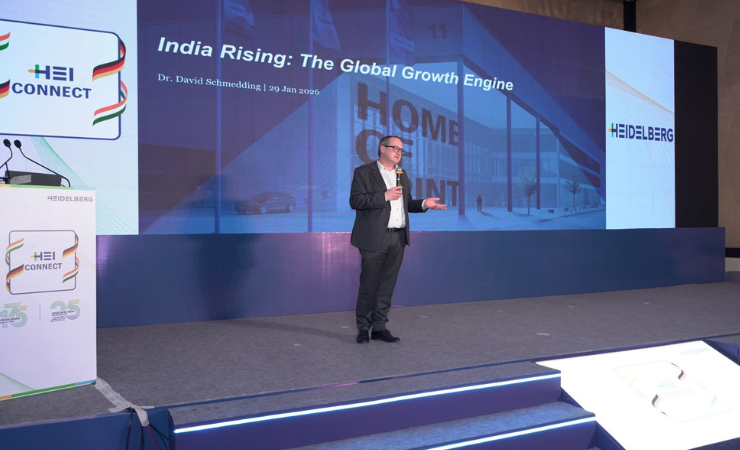
Dr. David Schmedding, chief technology and sales officer at Heidelberg, recently visited India to meet customers and partners, describing the market as one of the most dynamic globally. He said the company’s ambition is to act as a systems integrator in India, offering end-to-end solutions covering printing, finishing, software, consumables, service and training from a single source.
To support this strategy, Heidelberg is expanding its local sales and service organisation, increasing the number of demonstration installations and strengthening its partner network. The aim, the company says, is to improve customer proximity and ensure its technology and workflows are closely aligned with local production requirements.
Demand for industrial-scale solutions is already evident, with strong interest in the Speedmaster CX 104 platform among Indian packaging and commercial printers. The press is positioned as offering a competitive price-performance ratio alongside flexible configuration options. Heidelberg also reports growing interest in its Boardmaster flexographic web press, particularly for high-volume food and beverage packaging, and in hybrid label solutions from its Swiss subsidiary Gallus.
India is expected to play an increasingly important role in Heidelberg’s Asia-Pacific growth strategy. According to CEO Jürgen Otto, the country is set to contribute a larger share of future sales and profitability. He added that a proposed trade agreement between India and the EU, which could lower tariff barriers over time, may provide an additional boost to the company’s long-term growth ambitions in the region.