
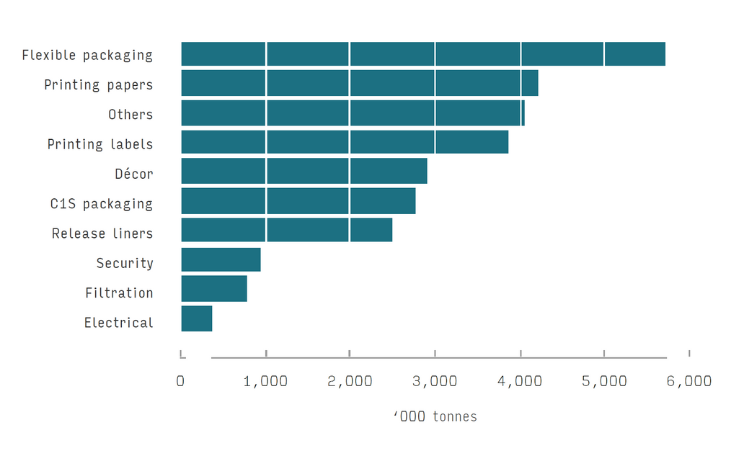
Smithers has released new data forecasting steady growth in the global specialty papers market, with consumption expected to reach 28.1 million tonnes in 2025 and rise to 31.3 million tonnes by 2030.
This represents a compound annual growth rate (CAGR) of 2.1% over the next five years, according to the research firm’s latest report. “The Future of Specialty Papers to 2030” tracks 45 specialty paper grades across global regions and individual countries.
The report highlights flexible packaging papers as a key driver of market expansion. Machine-glazed papers, which already represent about half of global sales, are projected to see the fastest growth, while coated (C1S) packaging papers are also expected to perform strongly as machine rebuilds progress in the US and new production capacity comes online in China.
Momentum behind plastic replacement is contributing to demand for advanced functional and barrier coatings. Manufacturers are investing in new chemistries, enhanced substrates, and alternative application methods, with nano-cellulose increasingly incorporated to boost performance. However, Smithers notes that evolving regulatory requirements, including design-for-recyclability initiatives, will add pressure on how coated and metallised papers can be effectively recovered within recycling streams.
Printing papers continue to represent a notable share of the market. While overall demand for printing substrates remains under long-term pressure, specific categories such as thermal paper and opaque lightweight grades are forecast to record solid growth.
Specialty paper producers are responding with investments in next-generation equipment, including smart control systems from chemical suppliers designed to optimise dosing, start-ups and shutdowns. Progress in curtain coating technology is also enabling the application of multiple functional layers in a single pass.
Asia-Pacific – especially China – remains the centre of gravity for specialty paper production. The region currently accounts for 46% of global output, a figure expected to rise to 48.7% by 2030, supported by continued capacity expansion and rising demand in markets such as India.